Saturday, 5 July 2014

Back to basics 2 - The Verb To Be


This is the second post in my 'Back to basics' series.  As I told you last time I'm working with a wonderful group of adults who prefer paper to technology;  I have been creating printouts to use in class and as with all my infographics, my objective is to transmit each grammar point in a simple, one page format. One of the main challenges of teaching this group, is finding a way to help them retain vocabulary.  By using only specific language in order to constantly recycle, I feel that I'm starting to make progress, it's a case of 'one step back, two steps forward':


This is the infographic that I created to introduce the verb - To be in the Present Simple tense:


Monday, 23 June 2014

How to get started as an online teacher of English

As winner of the British Council's Teaching English blog award last month, I was invited to write a guest post for their  'Voices' blog.  My post gives advice about how to get started as an online teacher:

How to get started as an online teacher of English


http://blog.britishcouncil.org/2014/06/18/how-to-get-started-as-an-online-teacher-of-english/
Online Teaching - Voices


If you have any ideas regarding this topic, please comment;  Google+ members please comment below.  If you're on Facebook please message me there and of course you can always send me an email: emma_segev@yahoo.co.uk

Thanks and I hope you found this post helpful :-)

Tuesday, 6 May 2014

The Present Simple 1 - Back To Basics

I am very proud to announce that this post has been awarded the 'Teaching English Blog Award for Innovative Teaching Ideas' by the British Council.

I would like to take this opportunity to thank Teaching English  for their support and thank everyone who voted :-)


This post is the first of a series of three, on the topic of the Present Simple tense. It contains a printable infographic covering the basics of the Present Simple and three printable worksheets.  


Getting back to basics:

If you've been following my blog, you'll know that I've been on a journey of discovery, concerning using technology to create materials and using technology to teach and study.  


A few weeks ago I began teaching a group of 12 adults face-to-face.   I was excited to get back into the classroom, I mainly teach online today, and try out some of my new creations on a group. I checked the equipment: I had a computer and projector, a fast internet connection and a full class.  I was ready and raring to go.....
We have had three lessons so far and I must say I'm thoroughly enjoying teaching the group.  It's a pleasure to teach face-to-face and a challenge to teach adults at this level; it's really great to get 'back to basics'.  This experience has reminded me that although using technology to teach is amazing, it's not always appropriate.  As teachers we shouldn't allow it to distract us as I did, from what is really important, 'the students'.  The truth of the matter is, the tools we use are far less important than the way we teach.

The minute the lights went out, the atmosphere changed in the classroom and I felt the tension rise.  One student couldn't see well, another said the writing was too small, another said she was getting too hot from the projector.  I had made an extremely basic mistake. The group's native language is Amharit, they have all had to learn Hebrew, so English is a third or for some of them a fourth language; at beginner level, the experience of a first lesson with a new teacher was daunting enough, without adding unfamiliar technology and teaching methods. Most of them don't have smart phones and for this group, this method, at this stage, was just not suitable.  So I switched off my overhead projector, sharpened my white board pen, dusted off my flash cards and reverted back to traditional methods.  


I have been working with the group on the topic of places in a town and shops.  I highly recommend using the lesson materials from the British Council's Teaching English website, my students really enjoyed them.  In our next lesson I'm going to use the language that we've worked on to introduce the Present Simple tense. I have created some printable materials in order to do this: 


Click on the link below to print or save:


Wednesday, 30 April 2014

Thoughts From Within - A Modern Poem

https://www.youtube.com/watch?v=Dj0GZQdCct8
Poem - Thoughts From Within 

In this post I have created a lesson based on a poem written by a famous actor (Advanced level)


Lesson Objectives:

  • It is designed for a one-to-one lesson, but could  be used with a group.  
  • Duration: 1 hour
  • The idea of the lesson is to give students a taste of some modern poetry in English. Students will expand vocabulary, use their imagination, improve their listening skills, practise expressing opinions, analysing text and recognising and interpreting figures of speech in poetry. They will also improve their pronunciation and poetry reading skills. 


Friday, 11 April 2014

Freedom


How would you define Freedom?  


This lesson is based on a wonderful article from the BBC Magazine concerning Freedom.  I created it for one-on-one lessons with Upper Intermediate and Advanced students.  However I'm certain that it would work just as well, if not better with a group.


Lesson Objective : 

The main objective of this lesson is to promote discussion, to encourage students to talk about the topic of freedom and the difference between the feeling of freedom and the state of freedom. In this lesson students will practise listening, expressing opinions, describing how something makes them feel, practise using comparatives and generally expand their vocabulary.  

Warm up:

Ask your students the following questions:
  • How would you define freedom?
  • When you think of the word freedom, what topics/issues/situations come to mind? (Prison/animals/war/slavery/media/religion/free time)
  • Can you think of any synonyms for the word freedom? (Exemption/immunity/liberty/ability)
  • Can you think of any antonyms for the word freedom?(Restraint/captivity/confinement/imprisonment/restriction/slavery)
  • Can you name some different types of freedom? (Discuss the meaning of each with your student:Freedom of speech/Political freedom/Physical freedom/National freedom/Freedom of belief/Freedom of the press/Economic freedom/Freedom of expression) 

Freedom 2014: What freedom looks like to you


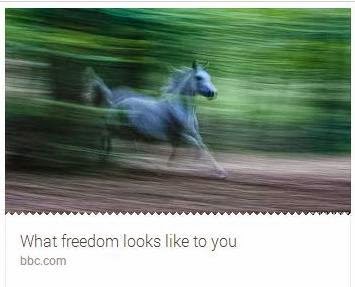
As part of the BBC's freedom 2014 season they asked their webpage viewers to send in photos of what 'freedom looks like to them'. They received more than a thousand responses and showcased them in the article that this lesson is based on.


http://www.bbc.com/news/magazine-26614481
BBC News Magazing: Freedom 2014